
Maintenance is most effective when it follows weather and building systems rather than an overwhelming generic checklist.
This guide approaches the subject as part of a complete home rather than a collection of isolated purchases. It explains what to observe, what to document and what to confirm before a decision becomes expensive to reverse.
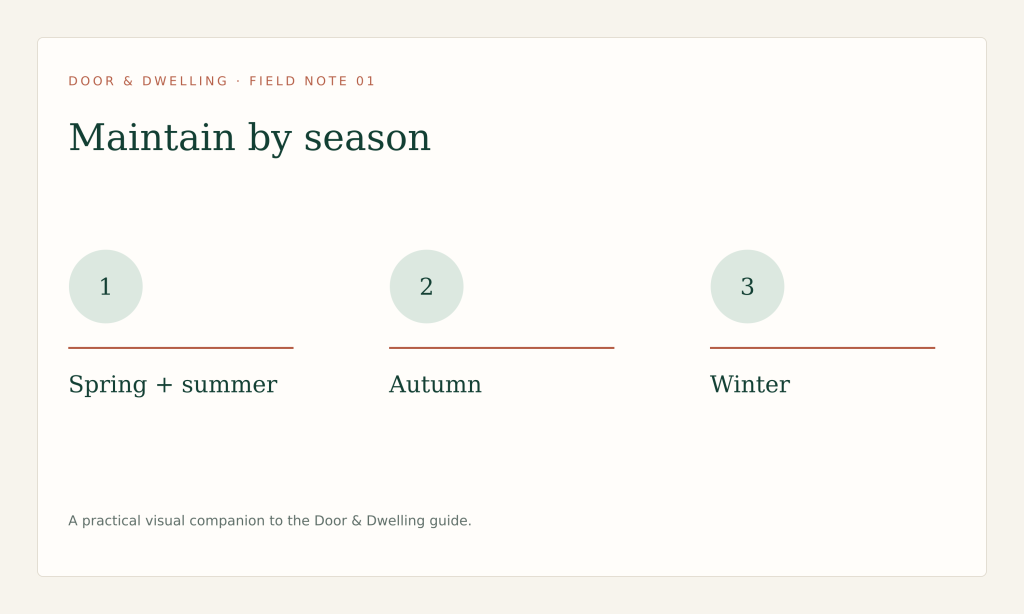
Spring: inspect after freeze and thaw
Winter can reveal drainage, roofing, masonry and grading weaknesses. This part of the project establishes the conditions that later choices must respect; treating it casually can create conflicts that appear only after money has been committed.
Early inspection finds conditions before spring rain compounds them. The strongest approach compares measurable performance with lived experience, because a technically possible answer is not always the most comfortable or maintainable one.
How to apply it
Walk the exterior and photograph changes. Work from verified dimensions and current product information, and make the decision visible in the drawings, schedule or written scope used by everyone involved.
Use professionals for roofs and unsafe access. Where regulations, structure, electrical work, fuel-burning equipment, waterproofing or health are involved, obtain advice from the appropriately qualified professional and confirm local requirements.
Before committing, compare the proposal with the conditions already present in the home. Photograph and measure what matters, note the assumptions being made and separate observations from preferences. This simple record gives homeowners and professionals a shared reference when details change.
Spring: manage water
Gutters, downspouts, drains, sump systems and grading direct water away from the building. This part of the project establishes the conditions that later choices must respect; treating it casually can create conflicts that appear only after money has been committed.
Small blockages can create concentrated moisture at foundations. The strongest approach compares measurable performance with lived experience, because a technically possible answer is not always the most comfortable or maintainable one.
How to apply it
Test systems safely and extend discharge appropriately. Work from verified dimensions and current product information, and make the decision visible in the drawings, schedule or written scope used by everyone involved.
Follow local discharge rules. Where regulations, structure, electrical work, fuel-burning equipment, waterproofing or health are involved, obtain advice from the appropriately qualified professional and confirm local requirements.
Treat this decision as part of a connected system rather than an isolated purchase. A choice that appears attractive on its own may affect circulation, maintenance, energy use, durability or later work. Review those consequences while changes are still inexpensive.
Summer: maintain exterior materials
Warm, dry periods suit inspection of coatings, sealants, decks and vegetation. This part of the project establishes the conditions that later choices must respect; treating it casually can create conflicts that appear only after money has been committed.
Plants touching buildings can retain moisture and conceal damage. The strongest approach compares measurable performance with lived experience, because a technically possible answer is not always the most comfortable or maintainable one.
How to apply it
Prioritize repairs that prevent water entry. Work from verified dimensions and current product information, and make the decision visible in the drawings, schedule or written scope used by everyone involved.
Follow product preparation requirements. Where regulations, structure, electrical work, fuel-burning equipment, waterproofing or health are involved, obtain advice from the appropriately qualified professional and confirm local requirements.
Mock-ups are especially valuable here. Samples, taped dimensions, temporary lighting or a scaled drawing expose practical problems that are difficult to see in a mood board. Evaluate the test during normal daily routines, not only when the room is tidy.
Autumn: prepare heating and enclosure
Service needs, filters, weather seals and exterior penetrations should be reviewed before sustained cold. This part of the project establishes the conditions that later choices must respect; treating it casually can create conflicts that appear only after money has been committed.
Early preparation provides time for qualified repairs. The strongest approach compares measurable performance with lived experience, because a technically possible answer is not always the most comfortable or maintainable one.
How to apply it
Test heating and safety devices according to guidance. Work from verified dimensions and current product information, and make the decision visible in the drawings, schedule or written scope used by everyone involved.
Never improvise combustion repairs. Where regulations, structure, electrical work, fuel-burning equipment, waterproofing or health are involved, obtain advice from the appropriately qualified professional and confirm local requirements.
Document the final decision, the reason for it and the person responsible for confirming it. Clear records help quotations remain comparable, reduce contradictory instructions and make future maintenance easier for whoever cares for the home next.
Regular observation is the least dramatic—and often most valuable—form of home care.
Winter: observe performance
Cold weather reveals condensation, drafts, ice and uneven temperatures. This part of the project establishes the conditions that later choices must respect; treating it casually can create conflicts that appear only after money has been committed.
These symptoms are evidence, not complete diagnoses. The strongest approach compares measurable performance with lived experience, because a technically possible answer is not always the most comfortable or maintainable one.
How to apply it
Record location, weather and timing for later assessment. Work from verified dimensions and current product information, and make the decision visible in the drawings, schedule or written scope used by everyone involved.
Treat serious moisture or combustion concerns promptly. Where regulations, structure, electrical work, fuel-burning equipment, waterproofing or health are involved, obtain advice from the appropriately qualified professional and confirm local requirements.
Restraint improves the result. Solve the essential performance requirement first, then add character through a limited group of materials, colours or details. When everything competes for attention, neither usefulness nor beauty is given enough room.
Year-round: keep records
A maintenance log connects small changes across seasons and supports warranties and future work. This part of the project establishes the conditions that later choices must respect; treating it casually can create conflicts that appear only after money has been committed.
Dates, photographs, invoices and product information are more useful than memory. The strongest approach compares measurable performance with lived experience, because a technically possible answer is not always the most comfortable or maintainable one.
How to apply it
Store records in one accessible place. Work from verified dimensions and current product information, and make the decision visible in the drawings, schedule or written scope used by everyone involved.
Update emergency contacts and shutoff information. Where regulations, structure, electrical work, fuel-burning equipment, waterproofing or health are involved, obtain advice from the appropriately qualified professional and confirm local requirements.
Revisit this choice at the end of the planning phase. Confirm that dimensions, budget, approvals, lead times and installation responsibilities still agree. A short coordinated review can prevent a small discrepancy from becoming site delay or rework.
Questions to resolve before proceeding
Ask what remains assumed rather than verified. Confirm dimensions, conditions, performance expectations, maintenance, lead times and the limits of each recommendation.
Review the proposal from the viewpoints of the daily user, the person maintaining it, the installer and a future owner. Test ordinary use, busy moments and foreseeable change.
How to apply it
Assign each open question to the person qualified and responsible for answering it, then record the answer in the shared project documents.
If the choice works only under ideal conditions, develop it further with a measured mock-up, sample or written scenario.
Before committing, compare the proposal with the conditions already present in the home. Photograph and measure what matters, note the assumptions being made and separate observations from preferences. This simple record gives homeowners and professionals a shared reference when details change.
Keep a useful project record
Save dated drawings, measurements, photographs, product sheets, colour references, quotations, approvals and written changes together.
Record model numbers and finish codes exactly, and note why important decisions were made. This continuity supports repairs and reduces contradictory instructions.
How to apply it
Review the record before ordering and again before installation; add warranties, care instructions and final photographs after completion.
Keep the completed file with the home so knowledge does not disappear with one inbox or contractor.
Treat this decision as part of a connected system rather than an isolated purchase. A choice that appears attractive on its own may affect circulation, maintenance, energy use, durability or later work. Review those consequences while changes are still inexpensive.
A considered next step
Create a dated home log with photographs, service records and recurring reminders, adapting this calendar to the building, climate and manufacturer instructions.
Explore more practical guidance in the Door & Dwelling story collection. Requirements, prices and product specifications change, so confirm project decisions with qualified professionals and the authority responsible for your location.
Putting the guidance into practice
The Essential Seasonal Home Maintenance Calendar becomes more useful when readers can move from general advice to a documented decision. This field guide connects organizing home care around climate, assemblies, safety and a durable record with the evidence, conversations and records required to apply it responsibly in a real home.
Create the permanent home record
Start with what is already true. For Create the permanent home record, document manufacturer instructions, previous repairs, visible change, weather exposure and recurring seasonal conditions before selecting a response. Look from the positions used in ordinary life and distinguish a measured condition from an assumption. This gives the decision a stable beginning and prevents an attractive reference image from standing in for information about the actual home.
Translate those observations into one plain-language objective connected to finding small changes early and keeping the home safe, efficient and easier to care for. A useful objective describes what should become easier, clearer or more durable; it does not prescribe a product too soon. Mark the relevant dimensions or conditions on a dated sketch so another person can test the same conclusion.
Do not advance until the record and the site agree. Where they conflict, compare current conditions with dated photographs and escalate unfamiliar or hazardous findings. That reconciliation is more valuable than adding detail to a drawing that began with the wrong premise.
Complete the spring recovery review
Observe the pattern, not one exceptional moment. When considering Complete the spring recovery review, note how the home performs during normal mornings, busy periods, quiet evenings and changing weather where relevant. The purpose is finding small changes early and keeping the home safe, efficient and easier to care for, so the test must reflect the routines the design is meant to support.
Photographs, temporary layouts and large samples make the discussion concrete. Label each test with its location and date, then compare inspection, cleaning, servicing, repair and professional assessment at appropriate intervals. Remove any option that depends on perfect behaviour, constant rearrangement or maintenance the household is unlikely to sustain.
Record what the test changed. Save the result with dated inspection notes, photographs, service invoices, model numbers, warranties and future reminders so the next decision begins with evidence rather than memory.
Use summer for exterior and landscape work
Read this decision as part of a connected system. Use summer for exterior and landscape work may affect circulation, light, moisture, storage, maintenance, energy use or later construction even when it first appears to be a self-contained choice. List those relationships before approving the visible result.
Compare inspection, cleaning, servicing, repair and professional assessment at appropriate intervals against function, longevity, visual calm, cost and reversibility. A strong option usually solves several priorities without requiring one feature to do everything. Name the trade-offs directly and decide which are acceptable for this household and project.
The central risk is that calendar reminders replace observation or encourage unsafe work beyond the homeowner’s competence. Ask what must happen first, which later tasks depend on this answer and who owns the final confirmation.
Prepare enclosure and drainage in autumn
Test the proposal at full or credible scale. For Prepare enclosure and drainage in autumn, a measured drawing, taped outline, physical sample or temporary arrangement will expose conflicts that a mood board cannot. Include nearby doors, furniture, controls, edges and travel paths rather than testing the preferred object in isolation.
Use the test during ordinary activity. Notice reach, glare, clearance, cleaning access, noise and the way more than one person uses the space. If a solution works only when the room is empty or staged, revise it before money and lead time are committed.
Photograph the accepted test and add its dimensions to dated inspection notes, photographs, service invoices, model numbers, warranties and future reminders. The installation team should be able to identify precisely what was approved.
Monitor winter moisture and equipment
Separate preference from performance. Monitor winter moisture and equipment can still be beautiful, but first establish the requirement it must meet. Use manufacturer instructions, previous repairs, visible change, weather exposure and recurring seasonal conditions to create a short list of non-negotiable conditions, then assess aesthetic choices inside those boundaries.
Review inspection, cleaning, servicing, repair and professional assessment at appropriate intervals with maintenance and ageing in mind. Ask how the option will be cleaned, repaired, adjusted and matched later. Restraint is useful here: a limited material or planting vocabulary often gives the important elements more presence and reduces contradictory instructions.
If performance information is incomplete, consult qualified roofing, electrical, mechanical, plumbing, arboricultural or building professionals as needed rather than converting uncertainty into a confident specification.
Schedule professional service intelligently
Coordinate the people as carefully as the materials. Before closing Schedule professional service intelligently, identify who designs, supplies, installs, inspects and maintains each relevant part. Shared responsibility without a named owner is a common source of gaps between drawings, quotations and site work.
Issue the same current information to everyone. Request written clarification where scope, dimensions or assumptions differ, and confirm whether a change affects price, schedule or another trade. This turns coordination into a visible task rather than a hope that separate conversations will align.
File the final answer with dated inspection notes, photographs, service invoices, model numbers, warranties and future reminders. Include the revision date and replace obsolete instructions in the active set.
Respond to warning signs promptly
Review risk before commitment. At Respond to warning signs promptly, identify what is concealed, variable, weather-dependent, regulated or difficult to reverse. The warning for this subject is that calendar reminders replace observation or encourage unsafe work beyond the homeowner’s competence. Rank uncertainties by consequence rather than treating every open question as equally urgent.
Reduce the important uncertainty through investigation, a written allowance, a sample, a professional opinion or a clear change procedure. If the issue touches structure, waterproofing, electricity, ventilation, fuel-burning equipment, accessibility or approvals, involve qualified roofing, electrical, mechanical, plumbing, arboricultural or building professionals as needed and confirm local requirements.
State the remaining risk plainly in the decision record. A known contingency can be managed; an unnamed assumption cannot.
Review and improve the calendar each year
Close the loop. Review and improve the calendar each year is complete only when the decision can be verified and understood by someone who was not present for the conversation. Review how it supports finding small changes early and keeping the home safe, efficient and easier to care for and check that the installed or specified result still matches the accepted evidence.
Complete a final walk-through from the viewpoints of the daily user, the person maintaining the work, the installer and a future owner. Correct omissions while access, trades and product information are still available. Note any seasonal or post-occupancy check that cannot be completed immediately.
Finish by saving dated inspection notes, photographs, service invoices, model numbers, warranties and future reminders. Add final photographs, care information, model numbers and the reason behind consequential choices.
A final editorial checklist
Confirm that important dimensions and conditions are verified, current information has reached everyone responsible for the work and unresolved questions have named owners. Read drawings, quotations, product information and schedules as parts of one project. Resolve contradictions in writing before ordering or authorizing work.
Review the result from the viewpoints of the daily user, the person maintaining it, the professional installing it and a future owner trying to understand what was done. Keep the completed record with the home and revisit the decision after occupation so later projects can benefit from what this one revealed.
Continue with the Door & Dwelling story collection, explore related renovation guidance and consult the publication’s editorial standards.
Continue exploring
Related from Door & Dwelling

Post
Heat Pumps Explained for Canadian Homeowners
Heat pumps move heat rather than create it directly. The right Canadian system depends on climate performance, sizing, distribution, controls, backup heat…
Post
How to Choose Paint Colours for an Entire Home
Build a connected whole-home paint palette by considering light, sight lines, fixed materials and the purpose of each room.
Post
Why Natural Light Changes the Way a Home Feels
Natural light influences comfort, colour, energy use and the rhythm of rooms throughout the day.
Post
A Practical Guide to Native Plants for Ontario Gardens
Choose Ontario native plants by ecoregion, site conditions, mature size and the habitat functions your garden can support.
Post
How to Design a Small Garden That Feels Generous
Make a compact garden feel larger through clear structure, layered planting, controlled views and useful destinations.
Post
Before You Renovate: The Decisions That Save Time and Money
The most valuable renovation decisions are made before demolition: scope, existing conditions, permits, team responsibilities, budget and a realistic sequence.Research
Sources & further reading
- Canada Mortgage and Housing Corporation — Home maintenanceCanadian housing guidance
- Health Canada — Indoor air qualityIndoor environment
- Natural Resources Canada — Keeping the heat inBuilding-envelope guidance