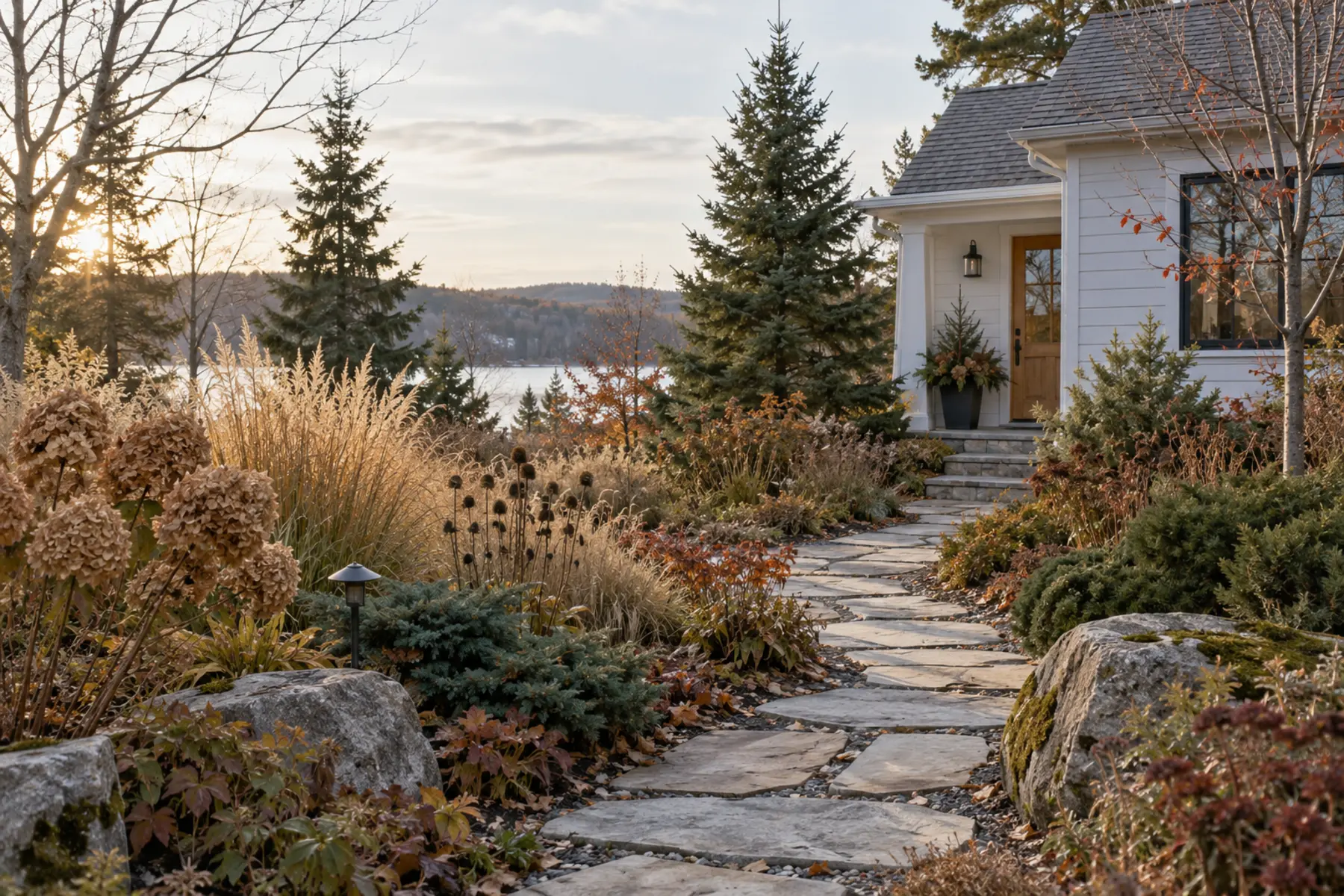
In much of Canada, the garden spends months without abundant flowers. That reality is an opportunity: form, bark, seed heads, stone, shadow and evergreen foliage can carry the composition.
Read the site closely
Sun, wind, drainage, snow storage, soil and nearby structures create conditions more specific than a regional hardiness zone.
Observe where spring snow lingers, where summer soil dries first and where reflected heat affects leaves. Existing volunteer plants also reveal conditions.
What to consider
Map sun and moisture at several points in the year before making a plant list; microclimates can vary significantly across one property.
Establish winter structure
Trees, shrubs, hedges, walls, paths and landform create the garden’s enduring outline. Their placement matters most when herbaceous growth recedes.
Choose structure for mature size and ecological fit rather than immediate fullness. Crowded young planting can become expensive and unhealthy.
What to consider
View the design from important interior windows as well as outdoors, because winter gardens are often experienced from inside.
Build layered planting
Strong planting combines canopy, understory, shrubs, perennials, grasses and ground layer where site conditions support them.
Layers create depth, reduce exposed soil and provide varied habitat. Repetition gives the complexity enough order to feel intentional.
What to consider
Use a limited group of dependable plants in meaningful quantities, then add seasonal accents instead of assembling one of everything.
Plan a sequence of change
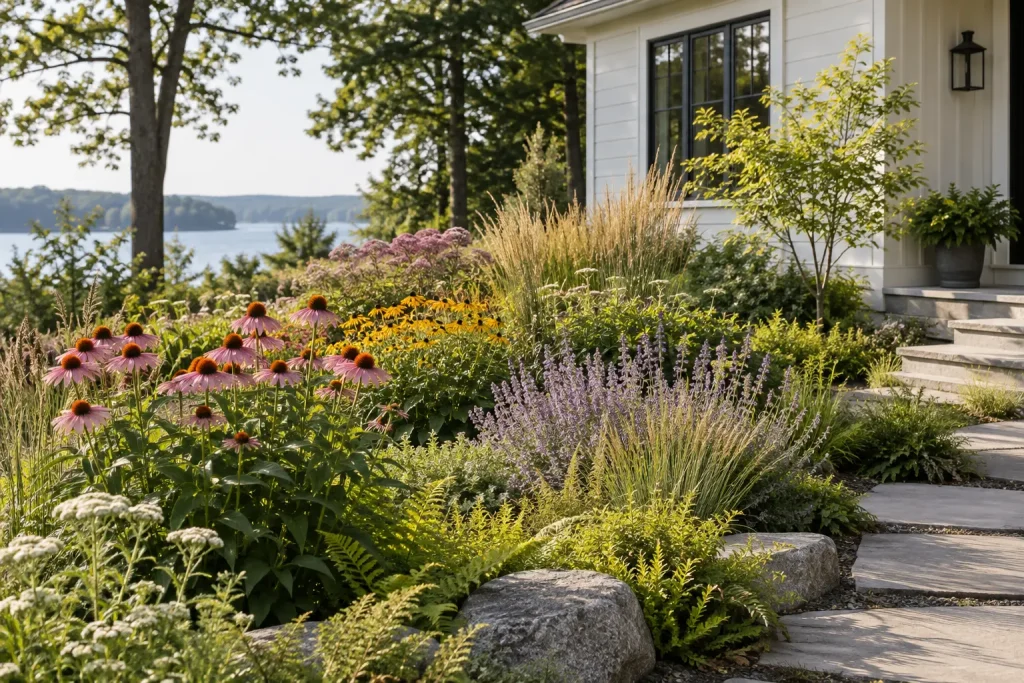
Aim for overlapping moments rather than continuous peak bloom. Buds, foliage, flowers, fruit, seed heads and bark all contribute.
Early resources can be valuable to emerging pollinators, while late flowers and persistent seeds extend habitat value.
What to consider
Make a month-by-month chart and mark what carries colour, texture, food or shelter during each period.
A garden becomes four-season when its structure remains legible after the flowers have gone.
Care for soil and water
Healthy soil supports roots, moderates water and makes plants more resilient. Avoid unnecessary disturbance and compaction.
Mulch, compost, grading and plant density influence moisture. Irrigation should establish plants efficiently without creating permanent dependence where possible.
What to consider
Test drainage before planting and group species with similar moisture needs rather than trying to make one watering schedule suit everything.
Choose regionally appropriate plants
A native plant is adapted to a region, not automatically to every garden condition. Match species to soil, exposure, moisture and available space.
Responsible diversity can increase resilience, but invasive species and locally regulated plants should be avoided.
What to consider
Consult current provincial, municipal and conservation-authority guidance because recommendations and restrictions change by region.
A practical next step
Photograph the garden in every season, identify the longest visual gaps and add structure before adding more varieties. Local conditions—not a national average—should guide every plant choice.
Continue with Door & Dwelling’s latest stories, where architecture, interiors, gardens and renovation are considered as parts of one connected way of living.
Putting the guidance into practice
A Canadian Guide to Creating a Four-Season Garden becomes more useful when readers can move from general advice to a documented decision. This field guide connects designing a Canadian garden whose structure remains legible beyond summer bloom with the evidence, conversations and records required to apply it responsibly in a real home.
Read climate and microclimate accurately
Start with what is already true. For Read climate and microclimate accurately, document local climate, exposure, snow, soil, drainage, mature form, evergreen structure and seasonal change before selecting a response. Look from the positions used in ordinary life and distinguish a measured condition from an assumption. This gives the decision a stable beginning and prevents an attractive reference image from standing in for information about the actual home.
Translate those observations into one plain-language objective connected to offering shelter, texture, colour and ecological value throughout the Canadian year. A useful objective describes what should become easier, clearer or more durable; it does not prescribe a product too soon. Mark the relevant dimensions or conditions on a dated sketch so another person can test the same conclusion.
Do not advance until the record and the site agree. Where they conflict, photograph fixed viewpoints in each season and adjust the longest visual or maintenance gaps. That reconciliation is more valuable than adding detail to a drawing that began with the wrong premise.
Establish durable spatial structure
Observe the pattern, not one exceptional moment. When considering Establish durable spatial structure, note how the home performs during normal mornings, busy periods, quiet evenings and changing weather where relevant. The purpose is offering shelter, texture, colour and ecological value throughout the Canadian year, so the test must reflect the routines the design is meant to support.
Photographs, temporary layouts and large samples make the discussion concrete. Label each test with its location and date, then compare trees, shrubs, grasses, perennials, hardscape and habitat features arranged in durable layers. Remove any option that depends on perfect behaviour, constant rearrangement or maintenance the household is unlikely to sustain.
Record what the test changed. Save the result with site plan, plant names, sources, planting dates, care notes and seasonal photographs so the next decision begins with evidence rather than memory.
Design the winter composition first
Read this decision as part of a connected system. Design the winter composition first may affect circulation, light, moisture, storage, maintenance, energy use or later construction even when it first appears to be a self-contained choice. List those relationships before approving the visible result.
Compare trees, shrubs, grasses, perennials, hardscape and habitat features arranged in durable layers against function, longevity, visual calm, cost and reversibility. A strong option usually solves several priorities without requiring one feature to do everything. Name the trade-offs directly and decide which are acceptable for this household and project.
The central risk is that planting is selected for one peak month while winter and transition seasons remain empty. Ask what must happen first, which later tasks depend on this answer and who owns the final confirmation.
Sequence spring, summer and autumn interest
Test the proposal at full or credible scale. For Sequence spring, summer and autumn interest, a measured drawing, taped outline, physical sample or temporary arrangement will expose conflicts that a mood board cannot. Include nearby doors, furniture, controls, edges and travel paths rather than testing the preferred object in isolation.
Use the test during ordinary activity. Notice reach, glare, clearance, cleaning access, noise and the way more than one person uses the space. If a solution works only when the room is empty or staged, revise it before money and lead time are committed.
Photograph the accepted test and add its dimensions to site plan, plant names, sources, planting dates, care notes and seasonal photographs. The installation team should be able to identify precisely what was approved.
Use evergreens with restraint
Separate preference from performance. Use evergreens with restraint can still be beautiful, but first establish the requirement it must meet. Use local climate, exposure, snow, soil, drainage, mature form, evergreen structure and seasonal change to create a short list of non-negotiable conditions, then assess aesthetic choices inside those boundaries.
Review trees, shrubs, grasses, perennials, hardscape and habitat features arranged in durable layers with maintenance and ageing in mind. Ask how the option will be cleaned, repaired, adjusted and matched later. Restraint is useful here: a limited material or planting vocabulary often gives the important elements more presence and reduces contradictory instructions.
If performance information is incomplete, consult a local landscape designer, horticulturist or arborist familiar with the site and region rather than converting uncertainty into a confident specification.
Retain seed heads, bark and habitat
Coordinate the people as carefully as the materials. Before closing Retain seed heads, bark and habitat, identify who designs, supplies, installs, inspects and maintains each relevant part. Shared responsibility without a named owner is a common source of gaps between drawings, quotations and site work.
Issue the same current information to everyone. Request written clarification where scope, dimensions or assumptions differ, and confirm whether a change affects price, schedule or another trade. This turns coordination into a visible task rather than a hope that separate conversations will align.
File the final answer with site plan, plant names, sources, planting dates, care notes and seasonal photographs. Include the revision date and replace obsolete instructions in the active set.
Plan paths, snow and maintenance
Review risk before commitment. At Plan paths, snow and maintenance, identify what is concealed, variable, weather-dependent, regulated or difficult to reverse. The warning for this subject is that planting is selected for one peak month while winter and transition seasons remain empty. Rank uncertainties by consequence rather than treating every open question as equally urgent.
Reduce the important uncertainty through investigation, a written allowance, a sample, a professional opinion or a clear change procedure. If the issue touches structure, waterproofing, electricity, ventilation, fuel-burning equipment, accessibility or approvals, involve a local landscape designer, horticulturist or arborist familiar with the site and region and confirm local requirements.
State the remaining risk plainly in the decision record. A known contingency can be managed; an unnamed assumption cannot.
Evaluate the same views every season
Close the loop. Evaluate the same views every season is complete only when the decision can be verified and understood by someone who was not present for the conversation. Review how it supports offering shelter, texture, colour and ecological value throughout the Canadian year and check that the installed or specified result still matches the accepted evidence.
Complete a final walk-through from the viewpoints of the daily user, the person maintaining the work, the installer and a future owner. Correct omissions while access, trades and product information are still available. Note any seasonal or post-occupancy check that cannot be completed immediately.
Finish by saving site plan, plant names, sources, planting dates, care notes and seasonal photographs. Add final photographs, care information, model numbers and the reason behind consequential choices.
A final editorial checklist
Confirm that important dimensions and conditions are verified, current information has reached everyone responsible for the work and unresolved questions have named owners. Read drawings, quotations, product information and schedules as parts of one project. Resolve contradictions in writing before ordering or authorizing work.
Review the result from the viewpoints of the daily user, the person maintaining it, the professional installing it and a future owner trying to understand what was done. Keep the completed record with the home and revisit the decision after occupation so later projects can benefit from what this one revealed.
Continue with the Door & Dwelling story collection, explore related renovation guidance and consult the publication’s editorial standards.
Review note — Read climate and microclimate accurately: Recheck the decision against local climate, exposure, snow, soil, drainage, mature form, evergreen structure and seasonal change. Confirm how it supports offering shelter, texture, colour and ecological value throughout the Canadian year, identify the person responsible for verification and add the result to site plan, plant names, sources, planting dates, care notes and seasonal photographs. This final pass is particularly valuable when quotations, product information, dimensions or project conditions have changed since the first review.
Review note — Establish durable spatial structure: Recheck the decision against local climate, exposure, snow, soil, drainage, mature form, evergreen structure and seasonal change. Confirm how it supports offering shelter, texture, colour and ecological value throughout the Canadian year, identify the person responsible for verification and add the result to site plan, plant names, sources, planting dates, care notes and seasonal photographs. This final pass is particularly valuable when quotations, product information, dimensions or project conditions have changed since the first review.
Review note — Design the winter composition first: Recheck the decision against local climate, exposure, snow, soil, drainage, mature form, evergreen structure and seasonal change. Confirm how it supports offering shelter, texture, colour and ecological value throughout the Canadian year, identify the person responsible for verification and add the result to site plan, plant names, sources, planting dates, care notes and seasonal photographs. This final pass is particularly valuable when quotations, product information, dimensions or project conditions have changed since the first review.
Review note — Sequence spring, summer and autumn interest: Recheck the decision against local climate, exposure, snow, soil, drainage, mature form, evergreen structure and seasonal change. Confirm how it supports offering shelter, texture, colour and ecological value throughout the Canadian year, identify the person responsible for verification and add the result to site plan, plant names, sources, planting dates, care notes and seasonal photographs. This final pass is particularly valuable when quotations, product information, dimensions or project conditions have changed since the first review.
Review note — Use evergreens with restraint: Recheck the decision against local climate, exposure, snow, soil, drainage, mature form, evergreen structure and seasonal change. Confirm how it supports offering shelter, texture, colour and ecological value throughout the Canadian year, identify the person responsible for verification and add the result to site plan, plant names, sources, planting dates, care notes and seasonal photographs. This final pass is particularly valuable when quotations, product information, dimensions or project conditions have changed since the first review.
Review note — Retain seed heads, bark and habitat: Recheck the decision against local climate, exposure, snow, soil, drainage, mature form, evergreen structure and seasonal change. Confirm how it supports offering shelter, texture, colour and ecological value throughout the Canadian year, identify the person responsible for verification and add the result to site plan, plant names, sources, planting dates, care notes and seasonal photographs. This final pass is particularly valuable when quotations, product information, dimensions or project conditions have changed since the first review.
Review note — Plan paths, snow and maintenance: Recheck the decision against local climate, exposure, snow, soil, drainage, mature form, evergreen structure and seasonal change. Confirm how it supports offering shelter, texture, colour and ecological value throughout the Canadian year, identify the person responsible for verification and add the result to site plan, plant names, sources, planting dates, care notes and seasonal photographs. This final pass is particularly valuable when quotations, product information, dimensions or project conditions have changed since the first review.
Review note — Evaluate the same views every season: Recheck the decision against local climate, exposure, snow, soil, drainage, mature form, evergreen structure and seasonal change. Confirm how it supports offering shelter, texture, colour and ecological value throughout the Canadian year, identify the person responsible for verification and add the result to site plan, plant names, sources, planting dates, care notes and seasonal photographs. This final pass is particularly valuable when quotations, product information, dimensions or project conditions have changed since the first review.
Review note — Read climate and microclimate accurately: Recheck the decision against local climate, exposure, snow, soil, drainage, mature form, evergreen structure and seasonal change. Confirm how it supports offering shelter, texture, colour and ecological value throughout the Canadian year, identify the person responsible for verification and add the result to site plan, plant names, sources, planting dates, care notes and seasonal photographs. This final pass is particularly valuable when quotations, product information, dimensions or project conditions have changed since the first review.
Review note — Establish durable spatial structure: Recheck the decision against local climate, exposure, snow, soil, drainage, mature form, evergreen structure and seasonal change. Confirm how it supports offering shelter, texture, colour and ecological value throughout the Canadian year, identify the person responsible for verification and add the result to site plan, plant names, sources, planting dates, care notes and seasonal photographs. This final pass is particularly valuable when quotations, product information, dimensions or project conditions have changed since the first review.
Review note — Design the winter composition first: Recheck the decision against local climate, exposure, snow, soil, drainage, mature form, evergreen structure and seasonal change. Confirm how it supports offering shelter, texture, colour and ecological value throughout the Canadian year, identify the person responsible for verification and add the result to site plan, plant names, sources, planting dates, care notes and seasonal photographs. This final pass is particularly valuable when quotations, product information, dimensions or project conditions have changed since the first review.
Continue exploring
Related from Door & Dwelling
Post
How to Design a Low-Maintenance Front Garden in Ontario
Low maintenance is designed, not purchased. A resilient front garden starts with site conditions, fewer stronger plant communities and clear edges that…
Post
How to Create a Beautiful Shade Garden in Ontario
Shade is not one condition. Once the canopy, soil moisture and root competition are understood, an Ontario shade garden can be layered,…
Post
A Practical Guide to Native Plants for Ontario Gardens
Choose Ontario native plants by ecoregion, site conditions, mature size and the habitat functions your garden can support.
Post
How to Design a Small Garden That Feels Generous
Make a compact garden feel larger through clear structure, layered planting, controlled views and useful destinations.
Post
Window Replacement in Canada: What Homeowners Should Know
A window is glass, frame, installation and connection to the wall. Performance depends on all four—and on choosing the right product for…
Post
Open-Concept vs. Broken-Plan Homes: Which Layout Works Better?
Open rooms promise connection; defined rooms promise focus. The better plan is the one that supports the household, the building and the…Research
Sources & further reading
- Canadian Wildlife Federation — Gardening for wildlifeHabitat gardening
- Government of Canada — Plant hardiness siteCanadian hardiness mapping
- Royal Botanical Gardens — Gardening resourcesSouthern Ontario horticulture